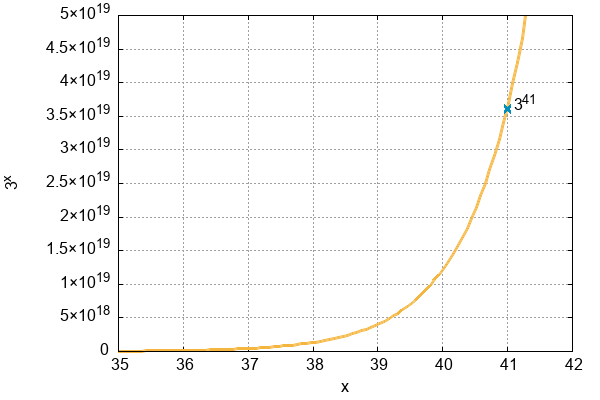
While computers are very good at doing arithmetic quickly, that speed comes with limitations. One such limitation is handling large numbers, especially when many bits of precision are required. While looking into the collatz problem, what first seemed to be a bug, turned out to be something a bit more interesting.
Tag Archives: collatz
Extending Collatz to Non-Integers Part 2
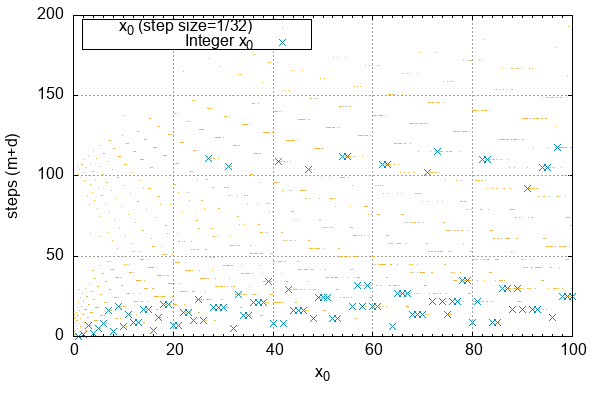
Typically, Collatz (or the 3x+1 problem) only applies to integer values for x, but what about non-integer x values? It has been shown that the number of steps to 1 can be computed for some non-integers, but are there more non-integers that also work?
Extending Collatz to Non-Integers
Typically, Collatz (or the 3x+1 problem) only applies to integer values for x, but what about non-integer values? Does Collatz even make sense for non-integers? Find out below.
The Collatz Conjecture: A Simple Counterargument
Recently, a proof of the collatz conjecture was presented. While the proof seems convincing, it does contain a critical flaw.
The Collatz Conjecture: A Simple Proof
The collatz conjecture, first proposed in 1937 by Lothar Collatz, is a problem that seems simple, but has confounded mathematicians, who have been unable to prove or disprove it, for decades. So, without further ado, here is a simple proof of the collatz conjecture.